
. Ferrosilicon
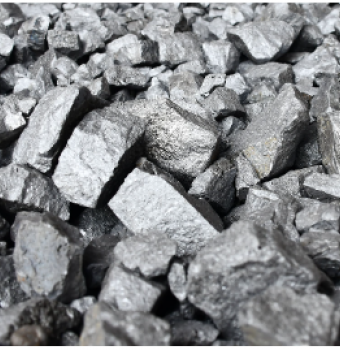
Ferrosilicon (FeSi)
Overview
Ferrosilicon (FeSi) is a ferroalloy primarily composed of iron (Fe) and silicon (Si). It is manufactured in various grades, typically containing between 15% and 90% silicon, with the most widely used commercial grades ranging from 70% to 75% silicon.
The product is generally supplied in lump, crushed, or graded forms and exhibits a metallic dark gray appearance. Owing to its excellent metallurgical properties, ferrosilicon is one of the most extensively consumed ferroalloys worldwide, serving as an essential raw material in the steelmaking and foundry industries.
Applications
Ferrosilicon plays a vital role in a wide range of metallurgical processes. Its primary applications include:
1. Deoxidizing Agent
The principal application of ferrosilicon in steel production is as a deoxidizer. Silicon has a strong affinity for oxygen and effectively removes dissolved oxygen from molten steel, preventing porosity, improving steel cleanliness, and enhancing the overall quality of the final product.
2. Alloying Additive
As an alloying element, ferrosilicon improves the mechanical and physical properties of steel and cast iron. It enhances strength, corrosion resistance, hardness, elasticity, and overall metallurgical performance.
3. Inoculant in Cast Iron Production
In foundry applications, ferrosilicon is widely used as an inoculant to control graphite formation in cast iron. This process improves the microstructure and significantly enhances the mechanical properties of cast iron components.
4. Reducing Agent
Ferrosilicon is also utilized as a reducing agent in the production of various metals. A notable application is the production of magnesium through the Pidgeon Process, where ferrosilicon serves as the primary reducing material.
Production Process
Ferrosilicon is produced through a high-temperature carbothermic reduction process in Submerged Arc Furnaces (SAF).
Raw Materials
The primary raw materials used in ferrosilicon production include:
-
Quartz (Silica Stone) – Source of silicon (SiO₂)
-
Iron Scrap or Steel Scrap – Source of iron (Fe)
-
Carbonaceous Reducing Agents – Including metallurgical coke, coal, and wood chips
Smelting Process
Inside the submerged arc furnace, large carbon electrodes generate intense electrical energy, producing temperatures exceeding 2,000°C within the reaction zone.
Under these conditions, carbon reduces silica (SiO₂) to elemental silicon according to the following reaction:
SiO₂ + 2C → Si + 2CO
The molten silicon subsequently combines with iron to form ferrosilicon alloy, which accumulates at the bottom of the furnace before being tapped.
Crushing and Classification
After solidification, the ferrosilicon alloy is crushed, screened, and classified into various particle sizes and silicon grades to meet diverse industrial requirements.